Pages

Showing posts with label Self help. Show all posts

Thinking Skills - Critical Thinking and Problem Solving

Title: Thinking Skills - Critical Thinking and Problem Solving
 Author: John Butterworth and Geoff Thwaites
 Language: English


    Thinking Skills, Second edition, is the only endorsed coursebook that provides complete coverage of the Cambridge AS and A Level Thinking Skills syllabus offering substantially updated, new and revised content. It also contains extensive extra material to cover related awards.

    Written by experienced and highly respected authors, this book includes features such as clearly focused and differentiated units, stimulating student activities with commentaries to develop analytical skills, summaries of key concepts to review learning, end-of-chapter assignments to reinforce knowledge and skills, and a mapping grid to demonstrate the applicability of each unit to awards including Critical Thinking, BMAT and TSA.

Read online / Download 

The Daily Stoic - 366 Meditations on Wisdom

Title: The Daily Stoic
Author: Ryan Holiday and Stephen Hanselman
Language: English


The Daily Stoic is an original translation of selections from several stoic philosophers including Epictetus, Marcus Aurelius, Seneca, Musonius Rufus, Zeno and others. It aims to provide lessons about personal growth, life management and practising mindfulness.

The book is intended to be read one page per day with each page featuring a quote from a stoic philosopher along with commentary. It is organised temporally and thematically across the twelve months of the year.

The Daily Stoic: 366 Meditations on Wisdom, Perseverance, and the Art of Living is a daily devotional book of stoic philosophy co-authored by Ryan Holiday and Stephen Hanselman.
It is Holiday's fifth book and Hanselman's debut as an author.

Read online / Download 

The Art of Happiness

Title: The Art of Happiness
Author: Dalai Lama
Language: English


    The book explores training the human outlook that alters perception.
The concepts that the purpose of life is happiness, that happiness is determined more by the state of one’s mind than by one’s external conditions, circumstances, or events—at least once one’s basic survival needs are met and that happiness can be achieved through the systematic training of our hearts and minds.

   The Art of Happiness is a book by the Dalai Lama and Howard Cutler, a psychiatrist who posed questions to the Dalai Lama. Cutler quotes the Dalai Lama at length, providing context and describing some details of the settings in which the interviews took place, as well as adding his own reflections on issues raised.

Part I. The Purpose of Life
Chapter 1: The Right to Happiness
Chapter 2: The Sources of Happiness
Chapter 3: Training the Mind for Happiness
Chapter 4: Reclaiming our Innate State of Happiness

Part II. Human Warmth and Compassion
Chapter 5: A New Model for Intimacy
Chapter 6: Deepening Our Connection to Others
Chapter 7: The Value and Benefits of Compassion

Part III. Transforming Suffering
Chapter 8: Facing Suffering
Chapter 9: Self-Created Suffering
Chapter 10: Shifting Perspective
Chapter 11: Finding Meaning in Pain and Suffering

Part IV. Overcoming Obstacles
Chapter 12: Bringing About Change
Chapter 13: Dealing with Anger and Hatred
Chapter 14: Dealing with Anxiety and Building Self-Esteem

Part V. Closing Reflections on Living a Spiritual Life
Chapter 15: Basic Spiritual Values

Read online / Download 

The Corpus Hermetica

The Corpus Hermetica
Author: Hermes Trismestigustos
Intro:


 The Hermetica are Egyptian-Greek wisdom texts from the 2nd century AD and later, which are mostly presented as dialogues in which a teacher, generally identified as Hermes Trismegistus ("thrice-greatest Hermes"), enlightens a disciple. The texts form the basis of Hermeticism. They discuss the divine, the cosmos, mind, and nature. Some touch upon alchemy, astrology, and related concepts.

The tradition and its writings date to at least the first century B.C.E., and the texts we possess were all written prior to the second century C.E. The surviving writings of the tradition, known as the Corpus Hermeticum (the "Hermetic body of writings") were lost to the Latin West after classical times, but survived in eastern Byzantine libraries.
Their rediscovery and translation into Latin during the late-fifteenth century by the Italian Renaissance court of Cosimo de Medici, provided a seminal force in the development of Renaissance thought and culture.
These eighteen tracts of the Corpus Hermeticum, along with the Perfect Sermon (also called the Asclepius), are the foundational documents of the Hermetic tradition.


Download

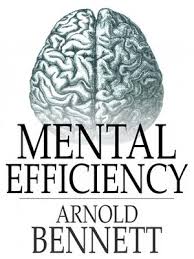
Mental Efficiency

Mental Efficiency
Author: Arnold Bennett
Intro:


 There are times when the whole free and enlightened Press of the United Kingdom seems to become strangely interested in the subject of "success," of getting on in life.
We are passing through such a period now. It would be difficult to name the prominent journalists who have not lately written, in some form or another, about success. 


Most singular phenomenon of all, Dr. Emil Reich has left Plato, duchesses, and Claridge's Hotel, in order to instruct the million readers of a morning paper in the principles of success! What the million readers thought of the Doctor's stirring and strenuous sentences I will not imagine; but I know what I thought, as a plain man. 


After taking due cognizance of his airy play with the "constants" and "variables" of success, after watching him treat "energetics" (his wonderful new name for the "science" of success) as though because he had made it end in "ics" it resembled mathematics, I thought that the sublime and venerable art of mystification could no further go.


Download

How to live 24 Hours a Day

How to live 24 Hours a Day
Author: Arnold Bennett
Intro:


 In the book, Bennett addressed the large and growing number of white-collar workers that had accumulated since the advent of the Industrial Revolution. In his view, these workers put in eight hours a day, 40 hours a week, at jobs they did not enjoy, and at worst hated.

 They worked to make a living, but their daily existence consisted of waking up, getting ready for work, working as little as possible during the work day, going home, unwinding, going to sleep, and repeating the process the next day. In short, he didn't believe they were really living.
Bennett addressed this problem by urging these "salarymen" to seize their extra time, and make the most of it to improve themselves.

 Extra time could be found at the beginning of the day, by waking up early, and on the ride to work, on the way home from work, in the evening hours, and especially during the weekends. During this time, he prescribed improvement measures such as reading great literature, taking an interest in the arts, reflecting on life, and learning self-discipline.

Download